Conference humbled by Thabitha's bravery
By Jane Aitchison
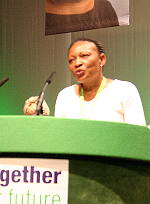 Thabitha
Khumalo, from Zimbabwe Congress of Trade Unions told Conference,
"I am absolutely humbled to be here." Thabitha
Khumalo, from Zimbabwe Congress of Trade Unions told Conference,
"I am absolutely humbled to be here."
It was Conference that was humbled listening to this brave and
dignified woman, who has continued her fight for human rights
in Zimbabwe in spite of the consequences - she's been arrested
frequently, suffered torture, kidnap, gang rape and beatings.
And by being here today and reporting the truth about the human
rights atrocities in her country, she risks being arrested on
her return home.
Thabitha spoke of the misery of people living in "abject, dehumanising
poverty". "The globalised world has taken up the Africa agenda
and the eradication of poverty," she said.
"But is poverty the problem of Africa? To me the problem is undemocratic
distribution, corruption and mismanagement."
The effects of Robert Mugabe's regime included 80% unemployment
and 1,200% inflation, repression and widespread suppression of
civil rights, and a decline in social and health services.
"There are 3 million Zimbabweans in Zimbabwe and 1 million Zimbabweans
in the UK whether legal or illegal. No person in their normal
mind can sell their house, resign from their job and pay 150 million
Zimbabwean dollars for a one way ticket."
As a result Zimbabwe is being deskilled as many of their nurses,
doctors, engineers end up in the UK, where most are not getting
the chance to use their skills and qualifications.
On the political situation in Zimbabwe, Thabitha said it was
never black and white and it was a question of a dictator trying
to hold on to power at whatever price -. Zimbabwe was once known
as the Jewel of Africa, and Mugabe's taken that jewel and put
it in his pocket.
She talked about the difficulties in organising the union -
to organise a conference, they need to apply for police permission
and without fail they say no. No more than three people can gather
at a time - 48 hours incarceration and a court appearance. Independent
media is forbidden from the country. The union newsletter could
mean another 48 hours in jail. It's forbidden to go outside of
the country and criticise the country and the authorities can
seize your passport.
A new law about to be introduced will give the authorities the
power to intercept cell phones, landline, e-mails and faxes.
"HIV and aids are ravaging Zimbabwe. People are dying of aids,
they cannot afford drugs. People are dying from curable illnesses
like malaria. The average life expectancy of women in Zimbabwe
is 34 - in the 21st Century young women finish university and
then we bury them.."
Thabitha, a diabetic can't afford insulin and controls her condition
as well as she can through diet. One packet of sanitary towels
or tampons costs a third of a woman's weekly wage - and most women
will need three - "We don't eat refined food - we bleed. Women
are forced to use whatever's available - old pieces of cloth,
newspaper or tree bark and are subject to terrible infections.
Thabitha's speech closed to a standing ovation, with a conference
moved to tears and in total admiration of the strength, courage
and dignity of this woman.
Dignity Period is the Campaign to bring back these Zimbwean women's
health and dignity through the provision of sanitary protection.
Click
here for how you can donate.
top
West Bank occupation must end, says Conference
Conference pledged to continue its campaign for an immediate
end to the Israeli occupation of the West Bank and for an independent
Palestine state alongside a secure Israel.
It pledged to continue to support projects with the Palestine
General Federation of Trade Unions (PGFTU).
And significantly UNISON will put together a plan to help dialogue
between the PGFTU and the Israeli Histadrut union federation to
create a wider civil society movement campaignng for peace and
economic justice.
In a key contribution, Scotland's Mike Kirby told Conference,
"One of Tony Blair's reasons for engagement in Iraq was to
mitigate the worst excesses of US intervention and to remind them
that Palestine is integral to any plan for peace in the region.
Britain would be an honest broker but Blair said that there will
be no negotiation of peace without an end to terrorism.
But as Uri Aunery of Israel Peace Movement Gush Shalom says,
this means "Until the armed opposition to occupation stops there
can be no talk of ending the occupation" A drastic stalemate but
a never ending disaster for the people of Palestine and Israel.
And if we have seen Israel withdraw from Gaza large settlement
blocks housing 80% of settlers in West Bank would be annexed behind
the separation wall and isolate Palestinians from Jerusalem.
I last visited West Bank and Israel last year as a guest of the
PGFTU and Histadrut. This was a significanttlis electing a new
labour leader. Since then the established democra step for both.
The new president Mahmood Abbas and the Israelis electing a new
Labour leader.
Since then the established democracy of the Palestinians elected
a HAMAS government. The first time an Arab democracy has seen
such a change.
All Palestinian groups opted for the election and there was a
smooth transition of power which has now been rejected by Bush
and Blair.
It is not our place to speculate on the reasons for such a change.
All should accept the results and yesterday saw a shift from HAMAS.
But there is a view that this is not a true reflection. It is
a result of occupation and oppression of social and economic conditions:
350,000 are unemloyed, 60% of the active labour force. 52% are
in poverty and this could be 75% by 2008 (UN figures)
Whatever you hear any corruption is minority problem but explored
by those opposed to peace and processes. The Israel reaction to
the election is to further delay and even Abu Hazen president
of HAMAS, a moderate of moderates, has been stunned.
Palestinians are subjected to further collective punishments
by Europe and others withdrawing aid and by the completion of
the apartheid wall.
So what is our role as trade unionists?
We deplore violence against people, violence from any quarter
section or state against any people. We can seek to influence
Governments but we cannot determine what happens.
However, we have seen in parts of the Israel where we organise,
that trade unions can bring people together. We have seen that
violence must end before the end can be considered. Our part is
described in the motion and amendment. It reflects the discussions
we have had with both trade union centres."
top
Call to restore pensions earnings link
UNISON laid out its strategy for the continued fight to protect
and improve pensions, demanding the immediate restoration of the
state pension's link with earnings and called for new laws preventing
unilateral cutting of final salary schemes.
Keith Sonnet, Deputy General Secretary congratulated local government
workers who took part in the largest strike action since 1926's
General Strike on March 28th.Whilst recognising the progress,
Keith warned " If negotiations break down there will be further
strikes which will shut down services across the country."
Slamming the continued attacks on occupational pension schemes,
he said, "We see scheme after scheme being shut down and who's
to blame? Blair and Brown. They stood still and did nothing to
stop companies ending schemes and they are responsible for the
attack on public sector workers' pensions."
"Over two million pensions live below the poverty line and this
country the fourth riches in the world depends less on pensions
than all other major industrialised nations."
Shirley Buchanan, Glasgow City, said "Tony Blair claims this
Labour Government fully supports and values the work of public
service workers and so they are protecting our pensions to ensure
we will not suffer!"
"Whose pension is Mr Blair protecting? Parliamentarans have not
only substantially increased their own pension rights, and have
the right to retire at 60 after 20 years service on an average
pension income for MPs of £28,743 a year - the Rule of 80
- remember that."
"That's more than what most of our members earn. And they have
the gall to tell us that we the taxpayers have to pay for their
enhanced pensions."
top |