|
A
manifesto for Scotland's public services
Section 4/4
Choosing quality services
It is also vital that the public services we provide
are of the best possible quality. Despite decades
of attacks, there are many examples of the benefits
high quality services provide.
The use in Renfrewshire of a Library
of Information for the Elderly, for example, helped
local elderly people secure over £1.7m to which
they were entitled, - six times the cost of the project.
Successful DLOs throughout Scotland (80% of those
trading according to the Accounts Commission) have
made net surpluses of £21m. Money to be reinvested
in local services - not to be removed from the system
as private profits.
The Scottish Parliament must ensure
that it is responsive to the demands of the Scottish
people in delivering the services they want.
Good services are not provided by cutting costs.
The best value for the Scottish people will be obtained
by providing quality services with trained, well treated
staff. Not on the cheap.
People not Profit
The best way of doing this is by using services owned
and run publicly, without a profit margin. Experience
in Scotland has shown that private involvement in
the provision of public services will almost always
result in a poorer quality service to the public.
Private ownership, maintenance, and running of our
public services means they would be less flexible,
less controllable and more expensive.
UNISON argues for publicly owned and run services,
not the quick-fix illusion and long term burden, of
schools, clinics and hospitals owned and run by the
private sector under the Private Finance Initiative.
These projects take away people's say, tie them into
inflexible contracts, and put a massive cost burden
on our children in the future.
To ensure accessibility to our Parliament and to
our public services we would support family friendly
policies such as improved nursery and childcare provision.
Equality built into our legislation and the positive
promotion of equal opportunities for all in access
to public services.
We urge the Scottish Parliament to enact
the recommendations of the Constitutional Steering Group
on Equalities in the Scottish Parliament to ensure the
equalities agenda is progressed from the start of the
parliament.
We believe that the parliament, and all the bodies
it is responsible for, should draw up plans to implement
equal opportunities. These should cover policy appraisal,
public access and information, and monitoring. There
is also a strong case for setting up a Human Rights
Commission and a Department of Equality.
A key priority is to combat the inequalities in health
care and to that extent UNISON welcomes the government
green paper - Working together for a healthier Scotland.
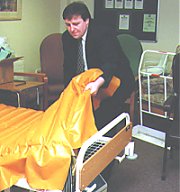 |
Jim
Cosgrove is the manager of the
Community Equipment Store based at St John's
Hospital in West Lothian. Managing a community
facility run jointly by the NHS Trust and
the local authority. he knows the benefits
properly integrated services can mean. |
| "Equipment
is delivered to people's homes following assessment
by professional community care staff. We can
carry an extensive range and we ensure that
professional staff can work together, and
ensure people's needs are taken into account." |
It should be clear that the parliament will assess
health care on the basis of need. The patient, whatever
their income, circumstances or position must be able
to access the best available care.
The emphasis on primary health care is one that should
be strengthened and increased, and action must be
taken to replace wasteful competition with co-operation
in the delivery of health care.
After years of being driven down the dead-end of
the internal market and competition, the Scottish
Parliament must reassert the public service ethos
at the heart of our health service.
The Parliament must support initiatives to bolster
community care, and encourage closer collaboration
between health services, local government and the
voluntary sector.
Lifelong learning for all is an important step towards
providing the support and back up to improve people's
lives. This, by its very nature, must be integrated
and responsive to people's needs across the generations.
To this end links between pre-school education, schools,
further and higher education, and community education
should be reintroduced, and be able to be democratically
controlled.
Above all the Parliament must ensure that Scotland
has the resources to provide the economic and logistical
infrastructure through services such as Scotland's
health and educational services, water and housing,
and an integrated transport system.
There must be no artificial barrier to using the
tax varying powers of the Scottish Parliament to provide
such resources.
The 'fair needs assessment' (or Barnett) formula
that determines Scottish share of total UK public
expenditure should continue.
A major step towards providing good quality, flexible
public services is the importance of these services
being integrated - working with one another to provide
holistic services. A good example of this is the Community
Equipment Store at St John's Hospital in West Lothian,
where staff from the local social work department
and health care trust work together to assess and
provide help to people who need physical aids and
equipment.
Planning for the community
UNISON would like to see the adoption of Community
Planning across a whole range of services. Public
services should be able to be determined and shaped
by the people who need them at a local level. Local
authorities are best placed to adopt the strategic
overview, allowing them to co-ordinate and integrate
as well as deliver, the services that people want,
when and where they want them.
This co-ordination will become increasingly difficult
where different sections of the service are run by
different companies/ trusts/authorities and quangos.
The team will become divided, locked into bureacracy
and set against one another.
Best value in service provision demands that services
can respond to people's needs quickly and efficiently.
This is best done by publicly owned and run services.
Not by privately run, inflexibility contracted, profit-motivated
companies. Private companies, by their nature have
to be profit motivated. That creates a conflict in
public service meaning that, even if the private sector
is involved, they should not own or run the service.
Choosing teamwork
To provide public services that are responsive, democratically
accountable and of high quality, parliament must recognise
the importance of the public service team. They are
the public faces of the service - the people who must
interpret funding decisions and policy changes to
the users. Through them the services are perceived.
This means that we must value all the team that provide
our services - treating them fairly and equally with
decent conditions and fair pay. Devices such as staging
pay awards should be scrapped, and the low pay problem
endemic in parts of the public services should be
tackled.
Team Spirit
If the team are all employed by the organisation
providing the service, they have a commitment to the
services they provide. This means the auxiliary as
well as the doctor; the school meals staff as well
as the teacher; the home help as well as the social
worker. From the cleaner to the chief executive.
The continued pressure towards 'outsourcing' via
PFI, trusts, market testing and others is unacceptable
and must be stopped. The Public Services Team must
be re-assembled to provide an integrated, flexible
accountable services with fairly, equally treated
staff. The provision of quality training at the workplace
is crucial, if the aim of lifelong learning for the
whole team - whatever their background - is to mean
anything at work.
In the voluntary sector in particular the Parliament
must find means to ensure that the staff working for
the sector have the same rights, security, conditions
and training opportunities that we expect for other
public services. Only then can we ensure consistency
of service, and quality of service.
|
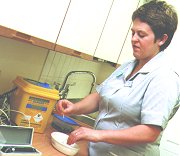
Maureen Gallagher is a
sister working in the Acute Trauma Unit
of the Western Infirmary in Glasgow.
"The treatment of health care staff
and services must be a top priority for
our Scottish Parliament" she says
|
 |
| "With
poor pay for most members of our team and
the continued bed and ward closures I often
feel like chucking it all in.
Many good colleagues have already done
so. The reason I don't is because I care
about this service. It should be the jewel
in the crown and if the Parliament can restore
the faith I once had then it will have been
worthwhile." |
The provision of proper training, job security and
conditions are a positive contribution to responsive
and high quality public services. These can best be
provided for by a directly employed team rather than
employees of a variety of private sector employers
and/or trusts with will have different aims, objectives
and vested interests.
Again to treat employees equally - providing family
friendly employment policies and promoting equal opportunities
is a positive contribution towards decently run public
services. These services can assist both their own
employees and those of other companies by providing
child care and training.
The Foxlea Family Centre and Paisley Learning Access
Network for example which provides affordable and
flexible childcare and provision of learning and education
for all ages. This allows parents to work and/or study
knowing their children are looked after by qualified,
trained and caring staff.
Services that treat their own team equally,
whatever their gender, ethnic origin, sexuality, age
or physical ability, will be positively placed to offer
an equal range of services to all Scotland's citizens.
Serving Scotland
Scotland's new Parliament is the time for a new chapter
in the tradition of serving the Scottish people.
It was created because the Scottish people made protection
of their public services a priority, defending them
throughout the eighties. They recognised that the
attacks being made then on their services would never
have come from a Scottish Parliament.
A positive partnership is the aim - a partnership
between central and local government, the health services,
the voluntary sector and educational institutions.
The partnership must be based firmly on the three
principles that have underpinned this document.
+ We must give people a say in their services.
+ We must choose quality services.
+ We must choose teamwork to provide our public
services.
UNISON will be promoting this positive agenda for
Scotland's public services in the coming months, raising
the issues with other trade unions, political parties,
community and voluntary groups; with prospective MSPs
directly, and of course with our own members.
We are looking forward to the future with hope and
optimism. The public services we provide are important
to all our lives - important to the life of Scotland.
We fully intend that our campaign will ensure that
their importance is high on the priorities of our
Parliament and our
representatives.
Only then will we be able to say that
our public services are
© UNISONScotland
1998
Written, designed
and produced by UNISONScotland Communications.
Thanks are due to Alan Wylie
for all the photographs, West Lothian NHS Trust, West
Lothian Council and the Radnor Street Clinic. Thanks
are also due to all the people who agreed to take
part.
It should go without saying
that the policies contained herein are the responsibilities
of UNISONScotland alone, and not attributable
to any individual, or institution who co-operated
with the making of this manifesto.
Serving Scotland
is UNISONScotland's manifesto for Scottish public
services. It is published by UNISONScotland, UNISON
House, 14 West Campbell Street, Glasgow G2 6RX. Tel
0141 332 0006. It is printed by John S Burns and Sons,
25 Finlas Street, Glasgow G22 5DS.
It is available
in hard copy from the above address and in other forms
on request.
 campaigning for Scotland's
public services campaigning for Scotland's
public services |
|



 Index
Index